Upcoming Seminars
Past Seminars or Workshops
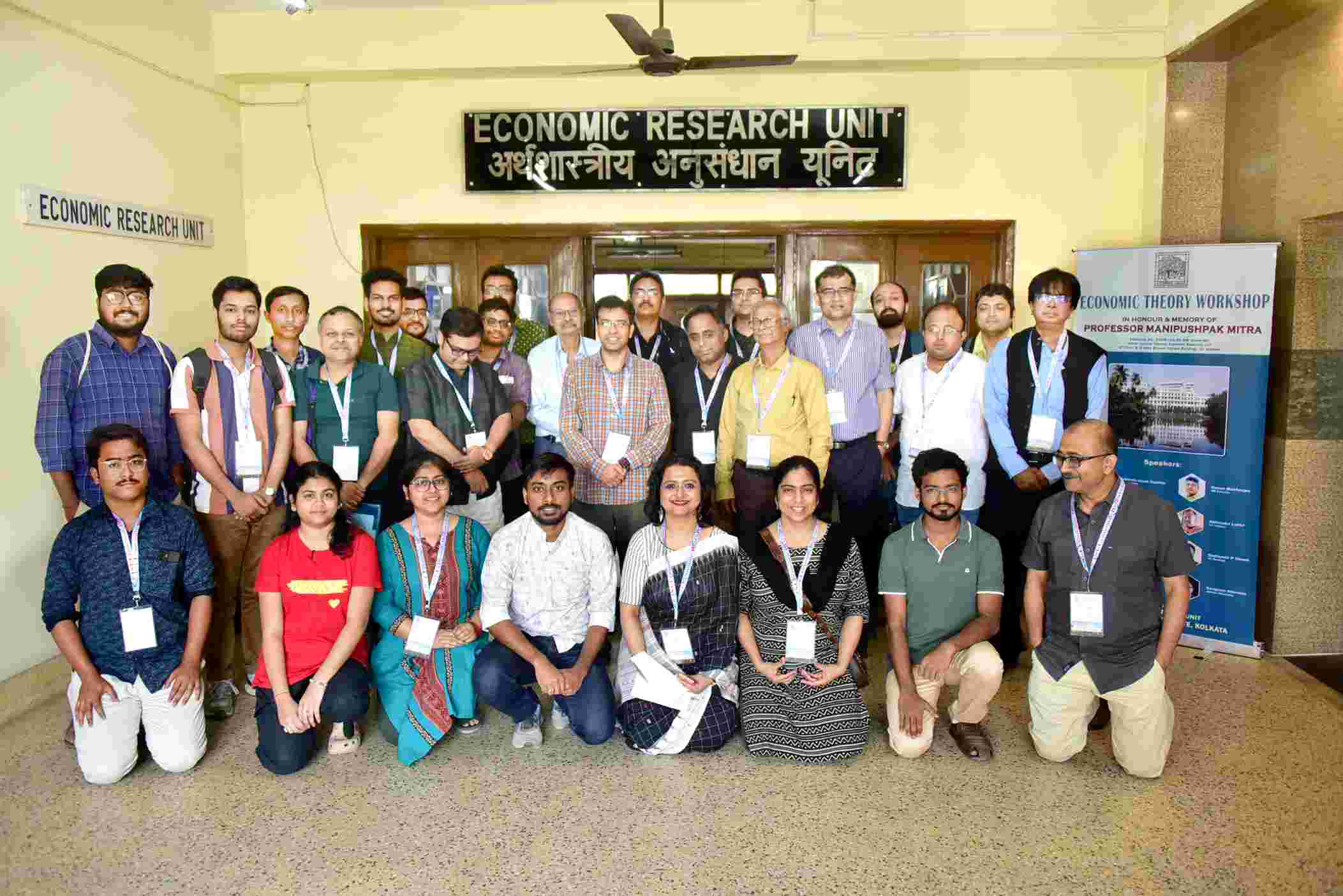
Economic Theory in Honor of Manipushpak Mitra
Venue: ERU Lecture Theatre, 6th Floor, SN Bose Bhavan, ISI
Date & Time: 26th Feb 2026
Economic transformation and social welfare: Rethinking Pathways to Local Solutions
Abstract: Economic transformation is a recurrent, endogenous feature of economies, but its trajectory and impacts are socially embedded. The central concern should not be whether the economy is undergoing economic transformation, but rather the nature, direction, and consequences of that transformation. Economic transformation should be assessed in relation to its contribution to social welfare and well-being, including its capacity to sustain economic growth, reduce inequality, promote social inclusion, and ensure ecological sustainability.. From 1990 to 2025, in a span of 35 years alone, global wealth has witnessed a multifold increase of almost three times - from $ 59.7 trillion in 1990 to $ 180 trillion in 2025. However, 75% ofglobal wealth is owned by the top 10%, 23% of global wealth by the middle 40%, and a meagre 2% of global wealth by the bottom 50% (World Bank, 2026). The top 10% captures 53% of total income, the middle 40% captures 38%, and the bottom 50% captures a meagre 8% of total income (at 2025 PPP). The inequality between regions is also immense-A person in Sub-Saharan Africa earns just € 300, South & Southeast Asia € 600, compared to € 3800 by a person in North America & Oceania, and € 2900 by a person in Europe (WIR, 2026). The statistics show that the Global South is most vulnerable to economic inequality. Income and wealth inequality, and social inequality, are not restricted to such inter-regional boundaries; there are large income and wealth disparities between rural and urban areas, between genders, and among other social groups. The central question here is: are we seeking such a global or regional economic transformation?. Economic inequality is not merely a structural outcome nor is it simply an outcome of any individual economic behavior; it emerges from the interaction among structural conditions, policy and institutional arrangements and the practices of economic actors. The contemporary economic transformation has not only expanded productive opportunities and generated prosperity, but has also witnessed the emergence and intensification of exploitative forms of economic behavior, resulting in exploitative gain; what we conceptualize here is the ashubh- labh. In such a scenario, protecting indigenous (rural) and marginalized communities from the unjust global economic order requires greater attention and locally appropriate solutions. Shubh-Labh is an emerging Indian economic approach that seeks to establish sustainable pathways towards a just transition and positive economic transformation. It creates an enabling space where material and non-material forms of wealth are balanced, thereby expanding the meaning of value beyond monetary returns. Through promotion of value creation, creativity, social innovations, cultural expression, and community well-being, Shubh-labh aims to generate value for both economy and society. It contributes to the development of a knowledge economy and a creative economy while ensuring that economic growth is aligned with social justice, ecological sustainability, and collective well-being.
Author: Hari Charan Behera
Venue: https://meet.google.com/cmm-ijnb-gzs
Date & Time: 19 August 2026, 4:00 PM
Econometric Analysis of Discrete Choice with Congestion
Abstract: We model discrete choice settings where the expected utility from choosing an alternative declines as more individuals choose it, e.g. travelling in rush-hour trains. We explore (i) existence/uniqueness of equilibrium without restricting functional form of utilities and dimension/distribution of unobserved heterogeneity and (ii) semiparametric identifiability of welfare effects of centralized allocation and of congestion charge. These interventions reduce the negative externality but also distort individual choice, making welfare effects theoretically ambiguous. We illustrate our methods with an application to college-choice by undergraduate admission candidates at Cambridge. We find that centralization reduces welfare uniformly, while a congestion charge produces net deadweight loss for males but a welfare gain for females.
Author: Debopam Bhattacharya
Venue: ERU Seminar Room, S N Bose Building, ISI Kolkata.
Date & Time: 2nd September 2026, 4:00 PM
REVEALED RATIONALITY FROM CHOICE PROCESSES
Abstract: We study what coarse process data reveal about rational information acquisition. The analyst observes only the joint distribution of final choice and search depth, not individual search histories. In a Weitzman environment, we derive an observable restriction, Early Cover, that identifies the latent reservation-value ordering under a support condition and, even without full support, identifies the ordering over all alternatives chosen with positive probability. We show constructively that, on the rich domain, Early Cover is also sufficient for exact Pandora rationalization. With heterogeneous optimal searchers, a directly observable depth-weighted violation statistic equals the minimum average Kendall distance from any benchmark over all latent rationalizing decompositions. Hence the minimum ranking heterogeneity required by the data is identified without recovering latent types or primitives. We apply the framework to platform manipulation of search costs, deriving directional demand effects and observable bounds on induced ranking distortions.
Author: Prof. Saptarshi Mukherjee, Humanities and Social Sciences, IIT Delhi
Venue: ERU Lecture Theatre Room, S N Bose Building, ISI Kolkata.
Date & Time: 9th September 2026, 12:00 PM